

Cloud Sync
Cloud Sync keeps your Raycast setup consistent on every device where you're signed in. The things you create — Quicklinks, Snippets, Notes, AI chats, themes, window management layouts, and more — sync continuously in the background, so a Snippet you add on your Mac at work is ready on your Windows machine at home. Even devices that have been offline catch up automatically, with nothing to export or merge by hand.
Get Started
Before turning on Cloud Sync, run the Export Settings & Data command to create a backup of your current setup. This makes sure you have a safe copy of your data to restore from in case anything goes wrong during the initial sync. We also recommend enabling scheduled exports so you always have a recent backup.
- If you're a macOS v2 user who hasn't run the Migrate from Raycast v1 command yet, do so first to bring your v1 data across. Skip this on Windows or if your app is already set up.
- Sign in to your Raycast account in Settings → Account — Cloud Sync requires a Pro subscription.
- Open Settings (⌘, / Ctrl,) and select Cloud Sync from the sidebar.
- Under Sync Preferences, choose which categories to include when Cloud Sync turns on. You can change your selection at any time later.
- Turn Cloud Sync on with the toggle in the top-right corner and confirm.
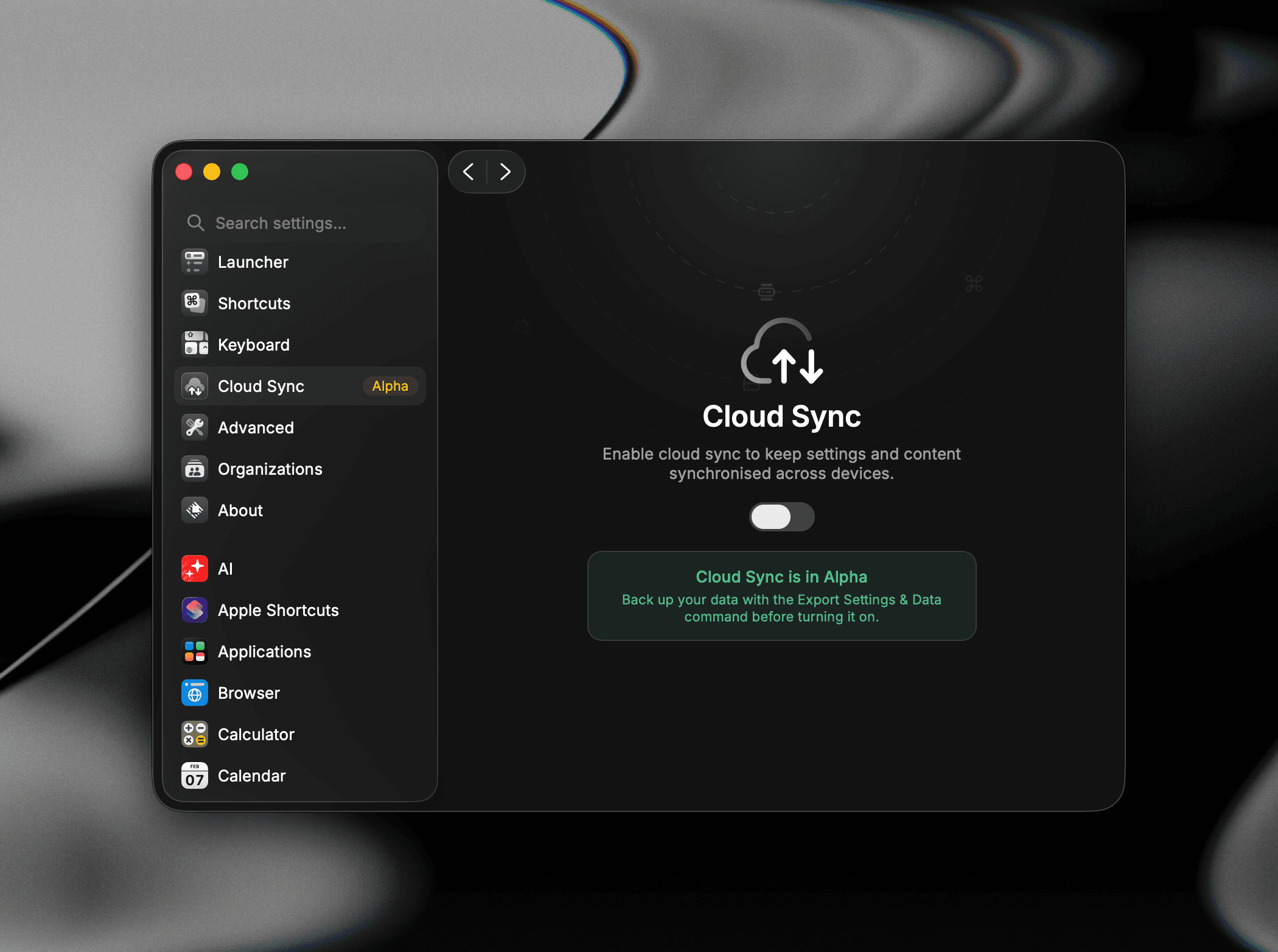
Cloud Sync requires a signed-in Raycast Pro account. If your session expires, syncing pauses and resumes once you sign in again. If you sign out, Cloud Sync turns off, and you'll need to re-enable it after signing back in.
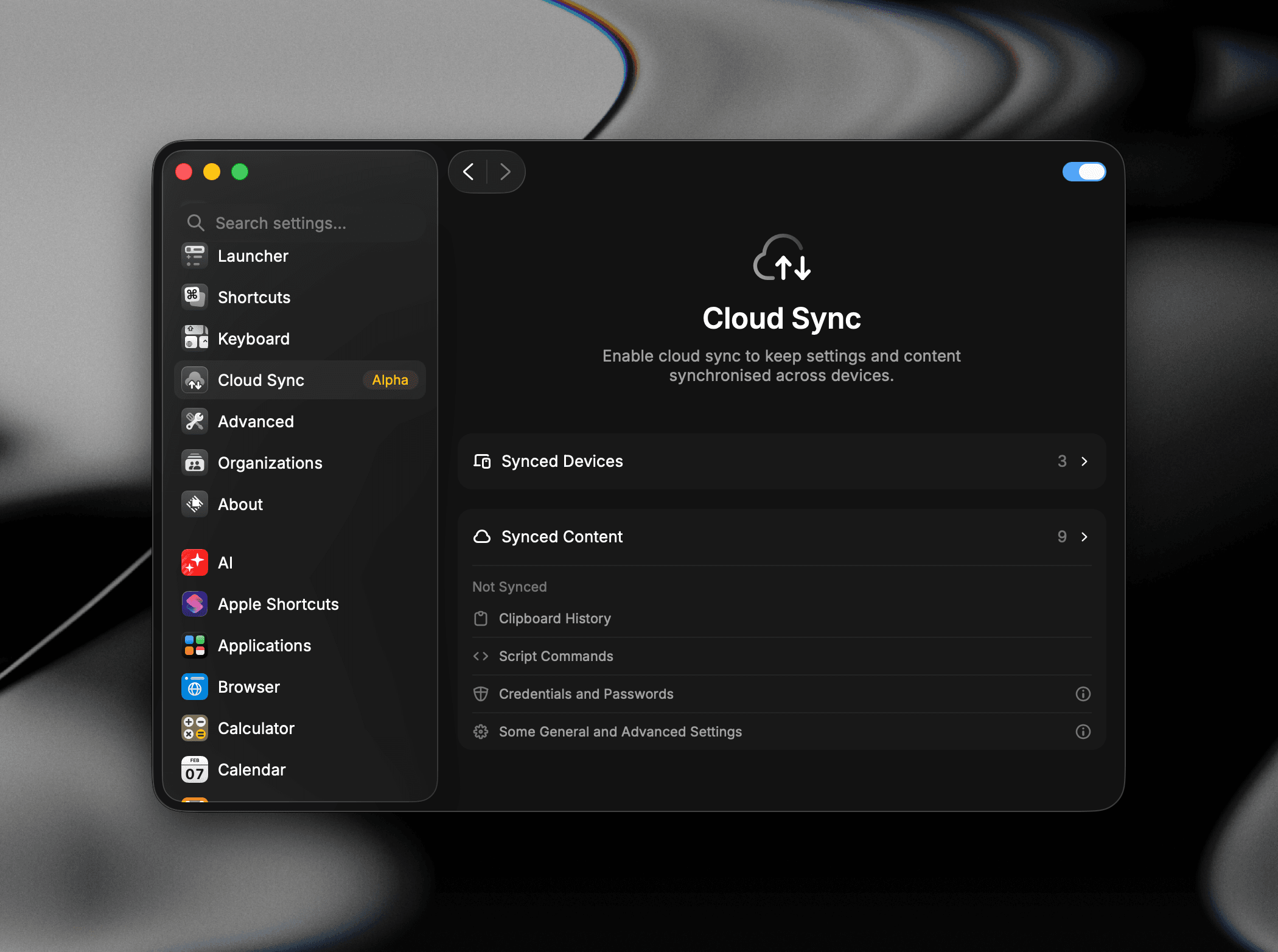
Once Cloud Sync is on, the settings page shows two screens: Synced Devices, listing every device connected to your account, and Synced Content, where you control what's kept in sync.
Choose What to Sync
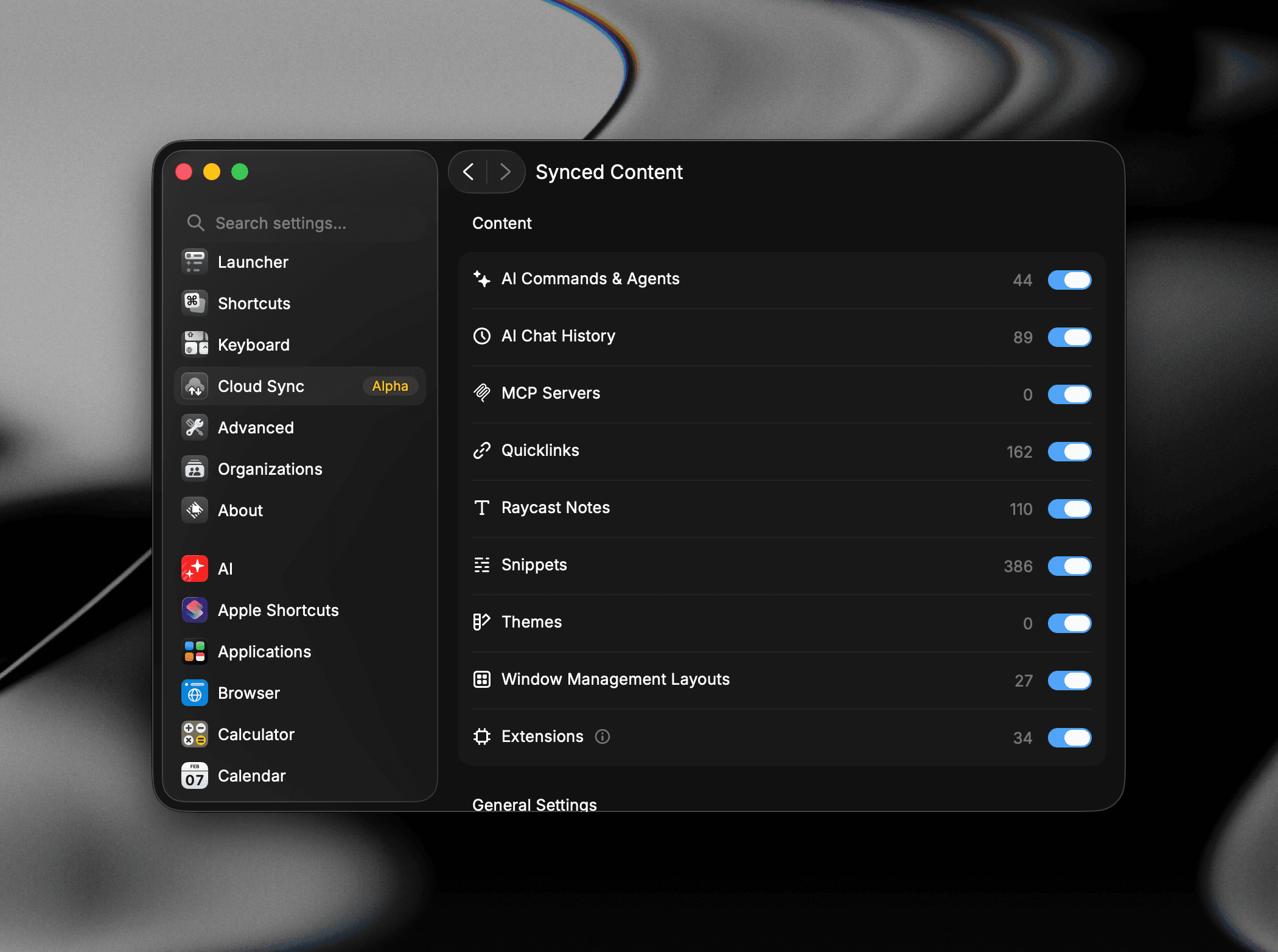
The Synced Content screen is where you control what's kept in sync. Each content category shows a live count of its synced items and a toggle to turn it on or off. While a device is still catching up, the count shows how many items are on this device out of how many are in the cloud.
Turning off an individual category pauses syncing for that category. It does not perform the whole-device sync reset described in Turn Cloud Sync Off.
Content categories
- AI Commands & Agents
- AI Chat History
- MCP Servers
- Quicklinks
- Raycast Notes
- Snippets
- Themes
- Transcription Styles
- Window Management Layouts
- Extensions: Extensions and commands sync across devices, but need to be enabled per device.
General Settings categories
- Open at Login
- Show in Menu Bar (Show in System Tray on Windows)
- Appearance
- Interface Size
- Window Mode
Some preferences are synced by default and can't be turned off: Some General Settings and Root Search Ranking. AI Chat History also always keeps the AI models and projects it depends on in sync, even if you turn off AI Commands & Agents.
Not Synced
Some data always stays on your device:
- Clipboard History
- Script Commands (scripts only; their settings sync)
- Credentials and Passwords: never synced, for security reasons
- Some General and Advanced Settings: device-specific settings stay on this device
Anything that doesn't appear in Synced Content — such as Screenshots, Search History, and your Export & Backup settings — is also not synced.
Manage Synced Devices
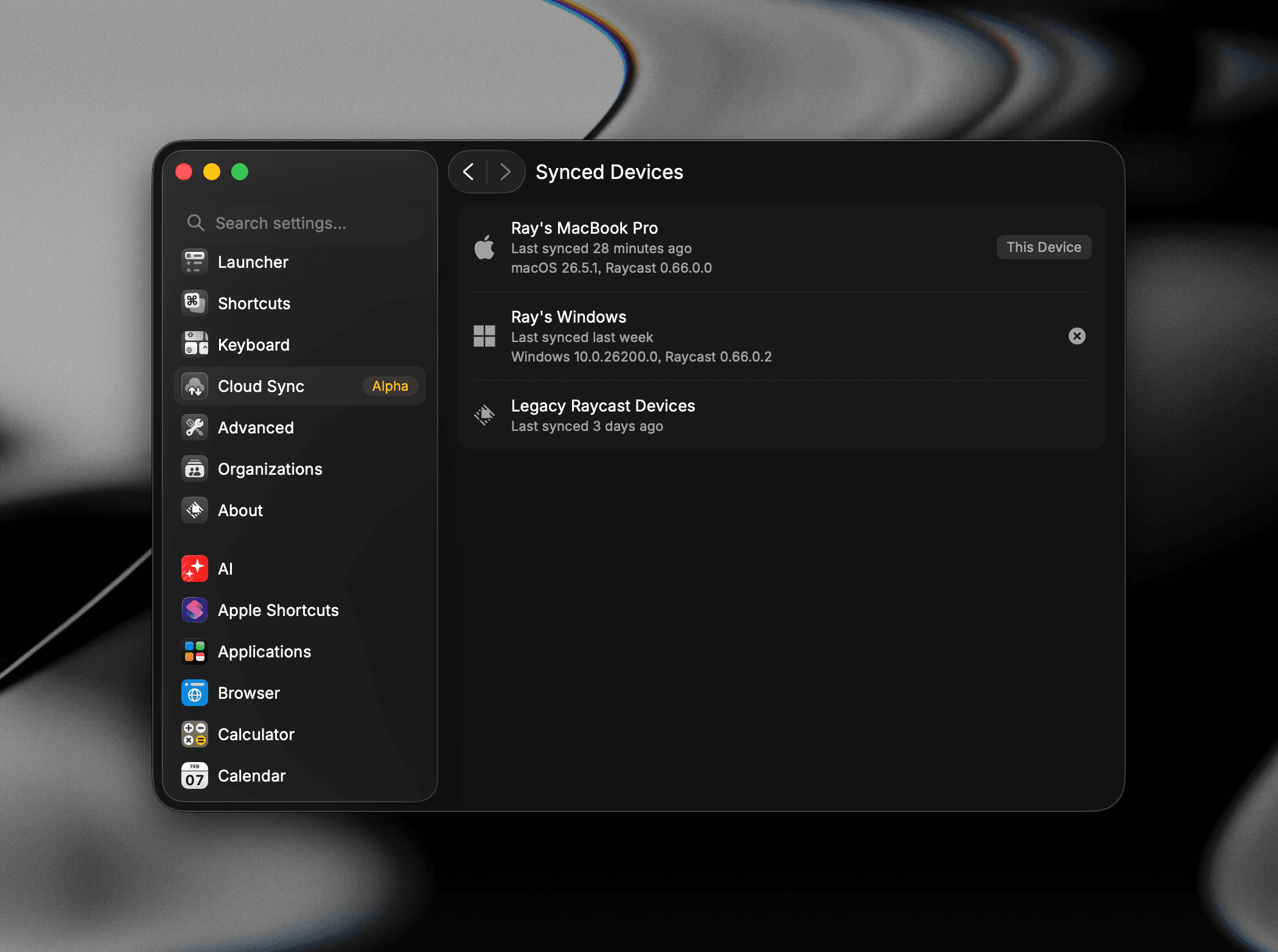
The Synced Devices screen lists every device connected to your account. Each entry shows the device name, its platform, OS and app version, and when it last synced. From there you can:
- Rename a device so it's easy to recognize — click its name and type a new one.
- Remove a device with next to it to stop it from syncing and revoke its access. The removed device stops syncing and clears its local synced state; the local data itself stays on that device.
Your current device is marked This Device, always appears at the top, and can't be removed.
Legacy Raycast & iOS Devices groups all of your Raycast v1 and iOS devices into a single entry. They sync through legacy Cloud Sync and can't be shown, renamed, or removed individually. The Cloud Sync settings shown here are exclusively part of v2, and Cloud Sync v2 for iOS is coming soon.
Turn Cloud Sync Off
Turning Cloud Sync off stops syncing on this device and keeps its current local content. It does not delete data from the cloud or your other devices.
Turning it on again starts a fresh sync. Settings changed while sync was off may revert to cloud values, deleted items may reappear, and local edits may be replaced by newer cloud versions. Changes or deletions that had not finished syncing before you turned it off may not reach other devices.
Before disabling Cloud Sync, let syncing finish and run Export Settings & Data to save a backup.
Do not turn Cloud Sync off and on to force a sync. If syncing is stuck, use Retry when available, restart Raycast, or contact support.
Delete Your Cloud Sync Data
Turning Cloud Sync off leaves your synced data on Raycast's servers and on your other devices, but resets this device's sync state as described above. If you want to remove that data from the cloud entirely, open Settings → Cloud Sync and, under the Danger Zone, use the Delete Cloud Sync Data & Devices button.
This permanently removes the data your account has synced to Raycast's servers, disconnects your synced devices, and turns off syncing on this device. Your local Raycast data stays on your devices. The button is available whenever your account still has synced data on the server, whether Cloud Sync is currently enabled or disabled on this device — so even if you've already turned Cloud Sync off here, you can still delete the data your account has previously synced to the cloud.
Delete Cloud Sync Data & Devices permanently removes your synced data from Raycast's servers and cannot be undone. This is different from turning Cloud Sync off, which leaves your server data intact. Make sure you have a recent backup (Export Settings & Data) before deleting.
Privacy & Security
Synced data is tied to your Raycast account and is encrypted in your device's local database, in transit, and in the server's database. Credentials and passwords are never synced. Raycast for Enterprise organizations can disable Cloud Sync for their members entirely with the Cloud Sync Control admin setting.
FAQ
Troubleshooting
Cloud Sync is designed to be hands-off, but a few rough edges remain — especially around bridging data between v1 and v2 devices. Here are the known issues and what to do about them.