

Quicklinks
Quicklinks turn the places you open every day into fast, searchable shortcuts. Save a website, search URL, file path, folder, or deeplink, then open it from Root Search by name. Use them for anything you open repeatedly: a project folder in your editor, a customer dashboard, a Notion page, a Spotify playlist, or a search engine with arguments.
Use the Create Quicklink command to add a quicklink, or Search Quicklinks to browse your library. Quicklinks also appear directly in Root Search alongside commands and applications.
Create a Quicklink
- Open the Create Quicklink command.
- Enter the Link. This can be a website URL, file path, folder path, or deeplink.
- Give the Quicklink a Name & Icon. Raycast will automatically use the favicon when a website URL is entered.
- Select an app in Open With (Optional).
- Add Tags to organize related Quicklinks (Optional).
- Click Save Quicklink ⌘↵ / Ctrl↵ to create the Quicklink.
Add from Library
Rather than build one by hand, click Add from Library in Settings → Quicklinks and search hundreds of ready-made Quicklinks, with common ones like Google, Wikipedia, and YouTube featured at the top.
Picking one opens the Create Quicklink form pre-filled, with the search term already set up as a {argument name="Query"} placeholder, so you can adjust it before saving.
Supported Links
You can use Quicklinks to open a wide range of link types, including:
- Web URLs:
https://github.comorhttps://figma.com/file/... - File and folder paths:
~/Projects/my-appon macOS orC:\Projects\my-appon Windows - Deeplinks:
spotify://playlist/...orslack://channel/... - Search URLs:
https://google.com/search?q={argument name="query"}
Autofill
When you create a Quicklink, Raycast can automatically fill the link from your active browser tab or clipboard. Auto Fill requires Automation permissions and works with Safari, Chrome, and other popular browsers.
Dynamic Placeholders
Quicklinks support Dynamic Placeholders, which are replaced when the Quicklink runs. This lets one Quicklink adapt to the current date, clipboard, selected text, calculator result, or a value you enter when opening it.
Search and Manage Quicklinks
The Search Quicklinks command gives you a central place to browse, open, and manage your Quicklinks.
- Search by name to find a specific Quicklink.
- Filter by tag to narrow down your collection. Press ⌘P / CtrlP to open the filter menu.
Action Panel
Open the Action Panel ⌘K / CtrlK to discover more actions you can take with Quicklinks, including
- Open Quicklink
- Open With: Open the Quicklink in a different app than the set default.
- Edit: Change the contents of an existing Quicklink.
- Duplicate: Use an existing Quicklink as a starting point for a new one.
- Pin/Unpin: Keep your most used Quicklinks at the top of the Search Quicklinks command.
- Copy Name/Link
- Hide in Root Search: Keep a specific Quicklink hidden from Root Search.
- Create Quicklink: Add a new Quicklink from scratch.
- Move Quicklink: When part of an organization, move Quicklinks between your personal account and organizations.
- Delete Quicklink
Tags
Tags let you organize Quicklinks by project, client, team, or purpose. Assign one or more tags when creating or editing a Quicklink, then filter by tag in the Search Quicklinks command when your library grows.
Shared Quicklinks
With Raycast for Teams, you can give everyone the same fast path to the links your organization uses every day, from internal dashboards and documentation to staging environments, design files, and onboarding resources. Shared Quicklinks appear alongside your personal Quicklinks.
An Organization is required before you can create a Shared Quicklink. You can create an organization in Settings or through the Raycast website.
Create Shared Quicklink
- Open the Create Quicklink command.
- In Organization, select your organization.
- Complete the dialog with the Quicklink information.
- Click Save Quicklink ⌘↵ / Ctrl↵ to publish the Quicklink.
The Quicklink is then available to every member of the organization. Shared Quicklinks show the organization's avatar on the right side of the item and sync automatically between members.
Managing Shared Quicklinks
To manage Shared Quicklinks, use the Search Quicklinks command. You will see all your available Quicklinks appear by default, and can swap to view just your organization's Quicklinks by using the Organization filter in the Navigation Bar.
Use the actions available in the Action Panel ⌘K / CtrlK to Edit, Duplicate, Move, or Delete a Shared Quicklink. Raycast asks for confirmation before destructive actions. You can also manage Shared Quicklinks in Settings → Quicklinks where your organization's Quicklinks appear as a separate group from personal Quicklinks.
Import Quicklinks
Raycast can import Quicklinks from a JSON file using the Import Quicklinks command. This is useful for moving an existing setup into Raycast or sharing a set of Quicklinks with teammates.
JSON Format
The JSON file must contain an array of Quicklink objects. Each object supports these fields:
name: Quicklink title. Type:String(required)link: Quicklink URL. Type:String(required)iconName: Quicklink icon. Type:String(optional)openWith: Target app to open the Quicklink. Type:String(optional)
If no app is specified with openWith, the link opens in the default web browser. Deeplinks are routed by the browser.
If no icon is specified with iconName, Raycast uses the default Quicklink icon.
[
  {
    "link": "https://duckduckgo.com/?q={argument}",
    "name": "Search DuckDuckGo"
  },
  {
    "openWith": "Finder",
    "iconName": "folder-16",
    "link": "~/Downloads",
    "name": "Downloads"
  },
  {
    "openWith": "Music",
    "link": "https://music.apple.com/gb/station/apple-music-hits/ra.1498155548",
    "name": "Apple Music Hits Radio"
  },
  {
    "link": "shortcuts://run-shortcut?Name={Test}",
    "name": "Run Apple Shortcut"
  }
]
After the import completes, Raycast shows how many Quicklinks were added and how many duplicates were skipped. A Quicklink is considered a duplicate when another Quicklink has the same title and content.
Examples
- Search engines:
https://google.com/search?q={argument name="query"}to search Google from Raycast. - GitHub repositories:
https://github.com/{argument name="org"}/{argument name="repo"}to jump to any repo. - Project folders:
~/Projects/my-appopened in VS Code. - Internal tools: dashboards, staging environments, admin panels, and design files.
- Translation: a Google Translate URL with arguments for source language, target language, and text.
- Meetings: your team's standup Zoom or Google Meet link, pinned for fast access.
Settings
All Quicklinks settings live under Settings → Quicklinks.
- Show Link Previews: Display a preview of the website URL when browsing Quicklinks in the Search Quicklinks command.
- Prefer Existing Tabs: When a Quicklink points to a website URL already open in your browser, Raycast switches to that tab instead of opening another one. Supports Chrome, Safari, and popular Chromium and Webkit browsers.
- Pass Selected Text as Argument: Raycast can automatically pass selected text from the active application to Quicklinks with a single argument when invoked via hotkey.
- Show Warning Before Deleting Quicklinks
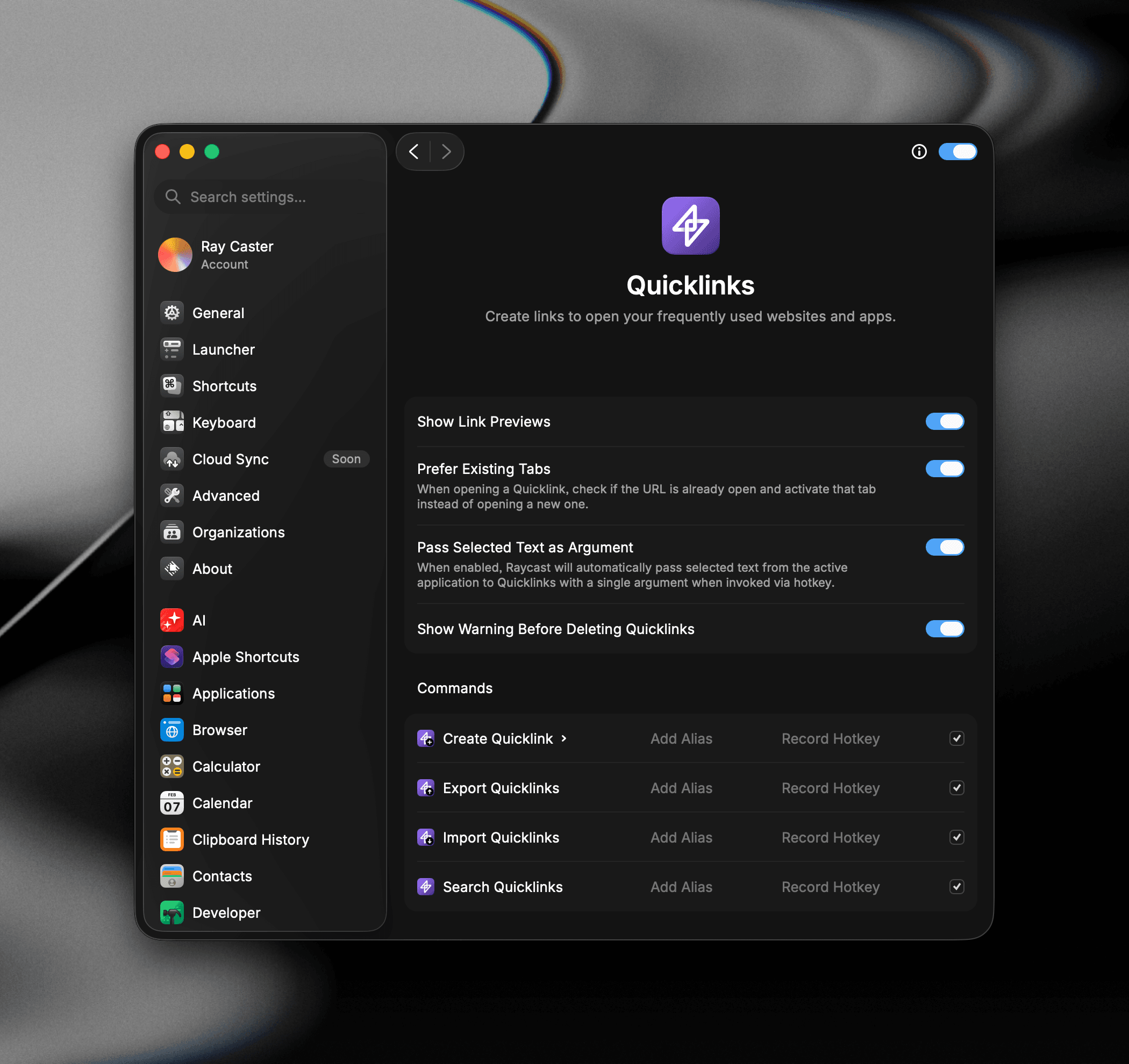
Commands
Assign aliases and hotkeys to the Quicklinks commands you use most:
- Create Quicklink: Open the Quicklink editor so you can save a new link. Toggle Autofill selected text to pre-fill the URL field with text selected in another app.
- Export Quicklinks: Save your Quicklinks to a file for backup or sharing.
- Import Quicklinks: Import Quicklinks from a JSON file.
- Search Quicklinks: Find and open a Quicklink from your library.
Quicklinks
Below Commands, you'll find your full Quicklinks library. Personal Quicklinks and Organization Quicklinks are grouped.
- Create Quicklink to add a new Quicklink.
- Add from Library to start from one of hundreds of ready-made Quicklinks.
- Assign an alias or hotkey to any Quicklink for faster access.
- Click the icon next to a Quicklink to edit, duplicate, copy, disable or delete it.
Permissions
Auto Fill needs Automation access to read the link from your active browser tab. Grant it in System Settings → Privacy & Security → Automation. Raycast prompts the first time you create a Quicklink if the permission is missing.