

Command Aliases & Hotkeys
Aliases and hotkeys let you launch any Raycast command faster. An alias is a short keyword you type into Root Search to jump straight to a command. A hotkey is a global keyboard shortcut that launches a command from anywhere on your system, even when Raycast isn't open.
Command Aliases
What is an Alias?
An alias is a custom short keyword that you assign to a command. When you type the alias into Root Search, the associated command is immediately prioritized in the results. For example, you could set gc as an alias for Google Chrome, or cb for Clipboard History.
Aliases appear as a small badge next to the command name in Root Search results, so you can always see which commands have aliases assigned.
How to Set an Alias
There are two ways to assign an alias:
From the Action Panel
You can now set aliases directly from Root Search without opening Settings.
- Select a command in Root Search.
- Press ⌘, / Ctrl, or open the Action Panel (⌘K / CtrlK) and choose Configure Command.
- Select Set Alias.
- Type your desired alias and press ↵ to save.
From Settings
- Open Settings → Shortcuts.
- Find the command you want (use the search bar or filters to narrow the list).
- Click the alias field (shows "Add Alias" as placeholder) and type your alias.
- Press ↵ or click away to save.
How Aliases Work in Root Search
Aliases use strict matching in Root Search, which makes them more predictable than regular fuzzy search:
- Exact match: Typing the full alias (e.g.
gc) places the command at the very top of results. This has the highest ranking priority. - Prefix match: Typing the beginning of an alias (e.g.
gforgc) still boosts the command in results, but lower than an exact match. - Alias + space: If a command has arguments, typing the alias followed by a space focuses the first argument field automatically.
Aliases don't use fuzzy matching. They use strict prefix matching, which means they're always predictable. This makes them ideal for muscle-memory workflows.
Alias Format
- Allowed characters: lowercase letters (a–z), numbers (0–9), and spaces.
- Aliases are automatically converted to lowercase when saved.
- Spaces in aliases are displayed as ␣ in the UI for clarity (e.g.
go␣compose). - Aliases can be single or multi-word.
- Special characters are not supported.
Changing or Removing an Alias
- To change: Edit the alias field (in Settings or via Action Panel → Configure Command → Set Alias) and type the new value.
- To remove: Clear the alias field entirely, or use Action Panel → Configure Command → Delete Alias.
Changes take effect immediately. No confirmation dialog or restart needed.
Hotkeys
What is a Hotkey?
A hotkey is a global keyboard shortcut that launches a Raycast command from anywhere on your system. Unlike aliases (which require Root Search to be open), hotkeys work even when Raycast is in the background. Press the key combination, and the command runs immediately.
Assigned hotkeys are displayed next to the command name in Root Search when the command is selected, using platform-appropriate symbols.
How to Set a Hotkey
There are two ways to assign a hotkey:
From the Action Panel
You can now record hotkeys directly from Root Search without opening Settings.
- Select a command in Root Search.
- Press ⌘, / Ctrl, or open the Action Panel and choose Configure Command.
- Select Set Hotkey.
- The keyboard shortcut recorder opens. Press the key combination you want to assign.
- The hotkey auto-saves after a short countdown, or press ↵ to save immediately.
From Settings
- Open Settings → Shortcuts.
- Find the command and click Record Hotkey.
- Press your desired key combination in the recorder popover.
- Save with ↵ or wait for auto-save.
The Hotkey Recorder
A redesigned, visual keyboard shortcut recorder with auto-save and real-time conflict detection.
When you record a hotkey, a popover appears with a visual key recorder. Here's what you'll see:
- Real-time key display: As you press keys, they appear as styled keyboard buttons in the recorder, so you can see exactly what you're recording.
- Auto-save with countdown: Once a valid combination is entered, a visual progress bar counts down (~1.5 seconds) before auto-saving. You can press ↵ to save immediately.
- Conflict warnings: If the combination conflicts with another command, the recorder highlights in red and shows which command owns the shortcut.
- Clear button: Click the
✕button to remove the current hotkey, or press Backspace while recording to clear.
Supported Key Combinations
A hotkey is typically a modifier key (or combination of modifiers) plus a regular key. Modifiers can also stand on their own: a multi-modifier combination (such as ⌥⌘ on macOS or CtrlShift on Windows) or a single modifier key (such as Right ⌘ or Right Ctrl) can be assigned as a hotkey. See Hotkey Types below.
Modifier Keys
⌘, ⌃, ⌥, ⇧, fn
Ctrl, Alt, Shift,
Modifier-only hotkeys can be tied to one side of the keyboard: a lone tap records the side you pressed, shown as a small L or R next to the modifier. Click the key in the recorder to cycle through left → right → any side, where any side means either key triggers it.
Regular Keys
Letters (A–Z), numbers (0–9), function keys (F1–F24), punctuation (.,;=-[]/\), and special keys (Return/Enter, Tab, Escape, Delete, Arrows, Home, End, Page Up/Down).
Hotkey Types
To give you a wider range of hotkey options we support a few different hotkey types:
Single Step
This is when you record your hotkey with one press of each key in the sequence. For example ⌥⌘A on Mac or CtrlShiftL on Windows
Multi-Modifier Hotkeys
You can assign hotkeys made up of more than one modifier key, such as ⌥⌘ on macOS or CtrlShift on Windows. This gives you more combinations to work with when single modifiers are already taken.
Double-Tap Modifiers
You can record a hotkey using a double-tap modifier: two quick presses of a modifier key, such as ⌘⌘ / CtrlCtrl. Release the key between the presses, since holding a modifier and then pressing its opposite side is a different gesture, covered in Both-Sided Modifiers.
Single-Tap Modifier Hotkeys
You can use a single modifier key as a hotkey, and left and right modifiers are treated separately. For example, Right ⌘ or Right ⇧ on macOS, or Right Ctrl or Right Alt on Windows, can each be assigned as their own hotkey, leaving the other side free for its normal use.
Both-Sided Modifiers
Holding both keys of the same modifier at once (left and right ⌘ together, for example) is a hotkey in its own right, separate from a ⌘⌘ double tap, and shows in the recorder as L⌘ R⌘. This only applies to modifier-only hotkeys: as soon as a regular key joins, both sides collapse into one, so left ⌘, right ⌘, and S records plain ⌘S.
Single Key
A single press of certain keys can launch a command, no modifiers needed.
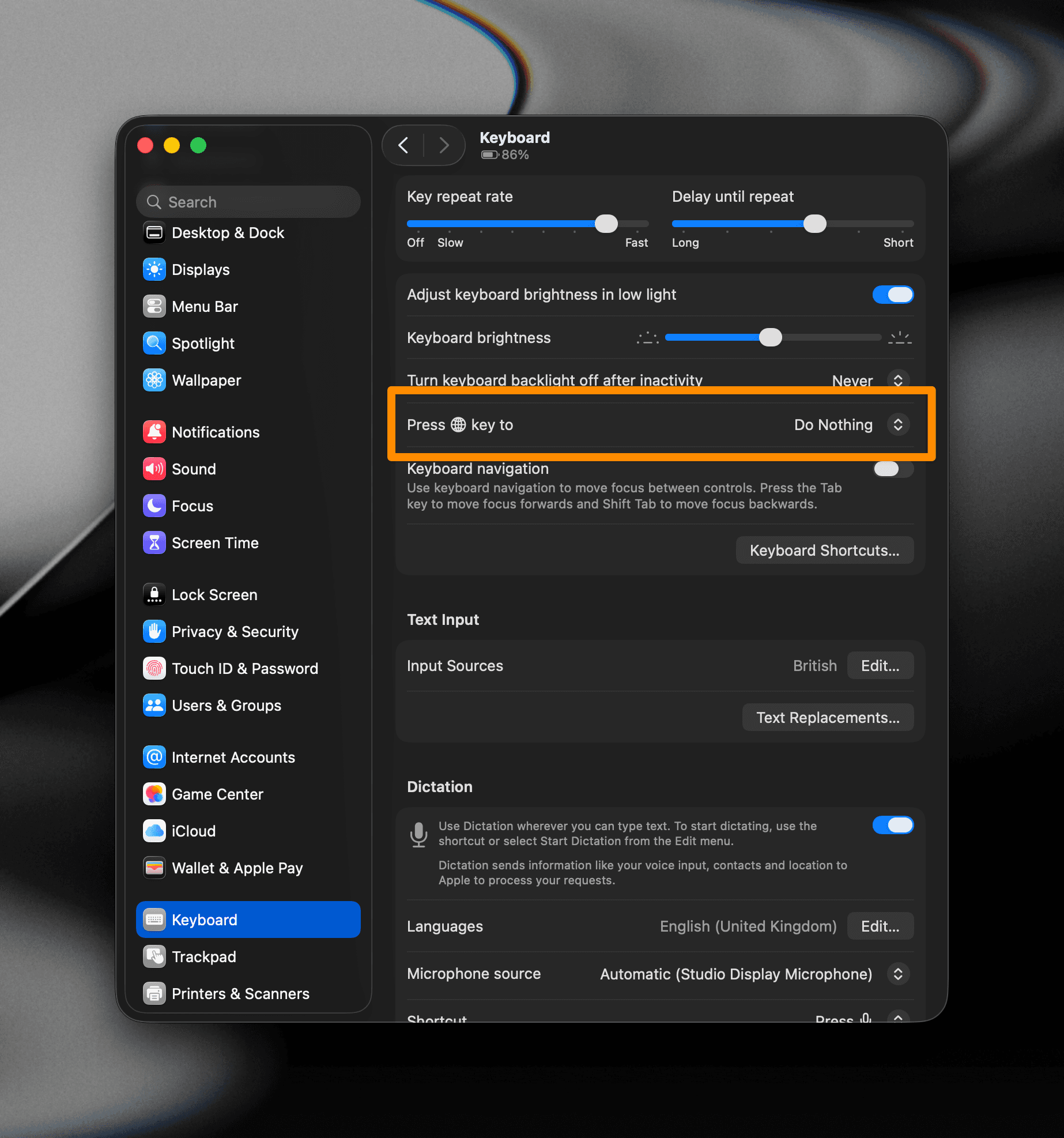
- You can assign the / fn key as a single-tap hotkey. Before recording it in Raycast, open System Settings → Keyboard → Press / fn key to and set it to Do Nothing so macOS doesn't intercept the press first. Users with an extended keyboard layout can also assign F13–F18 as single-tap hotkeys.
- You can assign the
key as a single-tap hotkey.
These keys can also be combined with other keys for more complex shortcuts, such as fnA, fnCtrlA, ⌘F13, or A.
Support for International Keyboards
You can now choose to record hotkeys as either physical keys or key equivalents, making it easier to switch between different keyboard layouts.
- Physical Key: The hotkey stays on the same key position across different layouts. For example, a hotkey recorded with the Z key on a QWERTZ keyboard corresponds to the Y key on a QWERTY keyboard.
- Key Equivalent: The hotkey maps to the same character regardless of layout. For example, a hotkey recorded with
Zon a QWERTZ keyboard remainsZwhen switched to a QWERTY layout.
By default, all hotkeys are recorded as phyical keys. You can configure this for each key. To do this:
- Open the hotkey recorder from Settings or via Root Search.
- Record your hotkey if one is not already set.
- Click on the key you wish to change.
- No blue dot on the key means it was recorded as a physical key. A blue dot indicates it was recorded as a key equivalent.
All built-in Raycast shortcuts use key equivalent keys, and this setting cannot be changed.
Conflict Detection & Overwrites
Improved conflict detection with the ability to overwrite conflicting shortcuts.
The hotkey recorder automatically detects conflicts at two levels:
Raycast Global Shortcut Conflict
If you try to assign a combination that's already used as Raycast's main launcher shortcut, you'll see an error: "Already used by Raycast." This type of conflict cannot be overwritten.
Command Conflict
If you try to assign a combination already used by another command, the recorder shows the conflicting command's name and icon with a red warning. You have two options:
- Choose a different combination: Press new keys to try a different shortcut.
- Overwrite: Save the shortcut anyway. The conflicting command loses its hotkey, and your new command takes over. The previous command will need to be reassigned if you still want it to have a hotkey.
Shortcuts That Can't Coexist
Raycast also flags hotkeys that can't both work, because one fires on a press the other is still waiting to complete. A single ⌥ tap conflicts with an ⌥⌥ double tap, and on macOS a side-agnostic ⌘ tap conflicts with a both-sided L⌘ R⌘ hotkey. Combinations using a different modifier are fine, since that press cancels the lone tap. A saved shortcut that conflicts with another shows a red dot, with a tooltip naming the command it clashes with.
Removing a Hotkey
- Click the
✕button next to the hotkey display in Settings or the recorder. - Or open the recorder and press Backspace to clear, then save.
- Or use Action Panel → Configure Command → Delete Hotkey.
The hotkey is removed immediately and the global shortcut stops working.
Managing Aliases & Hotkeys
The Shortcuts Settings Page
You can manage all your aliases and hotkeys from a single place: Settings → Shortcuts.
This page provides:
- A complete list of all commands with their aliases and hotkeys visible inline.
- Search to quickly find a specific command.
- Filters to narrow the view by category (Applications, Extensions, Quicklinks, System Actions, etc.) or by status (Hotkey Set, Alias Set, Enabled, Disabled).
- Inline editing: Click on any alias or hotkey field to edit it directly in the list.
Use the "Hotkey Set" or "Alias Set" filter to see all commands that already have shortcuts assigned. This is a great way to audit your setup and avoid conflicts.
Aliases vs. Hotkeys: When to Use Which
Both aliases and hotkeys speed up your workflow, but they serve different purposes:
- Use an alias when you want faster access to a command within Raycast. Aliases are great for commands you use often but not constantly: you open Raycast, type 2–3 characters, and you're there. They're easy to remember and you can have many without worrying about conflicts.
- Use a hotkey when you want instant access from anywhere on your system without opening Raycast first. Hotkeys are ideal for commands you trigger dozens of times a day, like clipboard history, window management, or your most-used translation pair. Since they're global, keep the number manageable to avoid conflicts.
- Use both for commands that you want to access both ways. A command can have an alias and a hotkey at the same time.